“À LA CARTE” WORKSHOPS
Exploring Topics Relevant to Parents
On Saturday afternoon, parents participating in the conference were able to choose from four workshops about topics closely related to their situations and their concerns: youth and sexual health, linguistic insecurity experienced by youth in minority settings, welcoming newcomers in our communities, and early childhood health. Here is a summary of each workshop offered.

Youth and Sexual Health: How to be an Approachable Parent
Talking about sexual and reproductive health with your child can be difficult. The goal of this workshop was to provide parents with guidelines to initiate these conversations, even from an early age, by choosing appropriate vocabulary for children, or at puberty or adolescence, in a way that helps to overcome the discomfort and taboos often associated with sexuality.
Based on the idea that it is better to discuss these topics with your children before someone else does (such as their friends or the Internet), this workshop, which was led by Tessy Vanderhaeghe, a sexual health educator and project leader at Réseau Femmes Colombie-Britannique, dealt with sexual health, mutual consent, and positive sexual behaviour in an inclusive, positive, and holistic way.
Ms. Vanderhaeghe coordinates the Jeunes leaders des relations saines program offered to secondary school students in several Conseil scolaire francophone de la C.-B. schools. Parents at the workshop had the opportunity to ask questions about this topic, and were able to share their experiences and also the questions that they face from their children, whatever age.
Often concerned about communication with their children during prepuberty and early adolescence, several parents appreciated the opportunity to openly discuss topics that included :
- How do I encourage communication with my child, and be ready to listen at the right time, when my child feels ready to communicate (... sometimes at the most unexpected times!)?
- How do I approach the topic when my child refuses to talk to me about it?
- How can I provide a safe and pressure-free environment for my adolescent to feel ready to talk about their experiences?
The workshop leader also shared resources and some good Internet addresses for finding help and information. With all the strong interest in this broad topic, some parents expressed a wish that a similar workshop could be offered in their community, to give more parents the chance to find answers to their questions.
Understanding Linguistic Insecurity in Youth
 This workshop was led by a dynamic team made up of young members of the Linguistic Security Committee of BC as well as Suzanne Robillard, a sociolinguist and PhD student at the University of Ottawa; they were accompanied by Clementine Creach of the Conseil jeunesse francophone de la C.-B. The workshop sought to raise awareness among parents about what linguistic insecurity actually is, and to help them understand how this phenomenon affects the lives of Francophone youth in minority settings.
Through short presentations, group exercises, and role-playing, participants became aware of how certain attitudes and behaviours could cause lack of confidence among youth, and also among adults. In this way, the parents realized that they can cause, perhaps unintentionally, a feeling of linguistic insecurity in their children -- for example, if they try to force their children to speak French, or if they correct their children when they speak French.
The workshop team also emphasized that it’s not a question of everyone speaking a certain type of French, like the “correct French” prescribed by grammar books, but rather that everyone just speaks French, regardless of their accent and how they speak. Therefore, a parent may simply act as a role model for speaking French, keeping a positive and constructive attitude.
The workshop generated some fascinating questions and discussion. Some parents admitted that it opened their eyes to the issues and challenges facing young people in our school communities, and others said that all parents living in minority settings should attend this workshop. In short, everyone who attended seemed to have gained a better understanding about the impact of their attitudes and actions on their children’s linguistic security.
Parents who would like practical advice and strategies to prevent their children from developing feelings of insecurity about French are encouraged to read a short article on this subject by Suzanne Robillard, published in the Fall 2019 edition of Parenthèse.
Welcoming Newcomers to our Communities: Who, Why, and How?
 This fascinating workshop, which brought together conference participants from several backgrounds, highlighted the importance of welcoming newcomers to our Francophone communities.
Workshop leader Patricia Garvey, who is the Supervisor of Travailleurs en établissement des familles immigrantes dans les écoles (TÉFIÉ) Services at the Conseil scolaire francophone (CSF), was able to illustrate, with humour and personal anecdotes, several factual and conceptual realities about the challenges that immigrant family members may face.
Some participants were surprised to find out that several resources had already been put in place by TÉFIÉ to support students, families, and youth, according to their respective needs. Welcoming newcomers is everyone's responsibility, including Francophone organizations and school parents' associations (APÉs). This was a key message that was not ignored or dismissed by the participants..
After some instruction and reflection, a brainstorming activity inspired the group to come up with ideas that would help integrate newcomers into the school and community, for example: publicize the free activities in the area as well as the services and resources of Francophone organizations; share and have discussions around a multicultural meal; create a location in the school where one could read the personal stories of newcomers displayed on posters; pair an arriving family with a member of the APÉ; hold a barbecue at the beginning of the year to meet newly arriving families; etc.
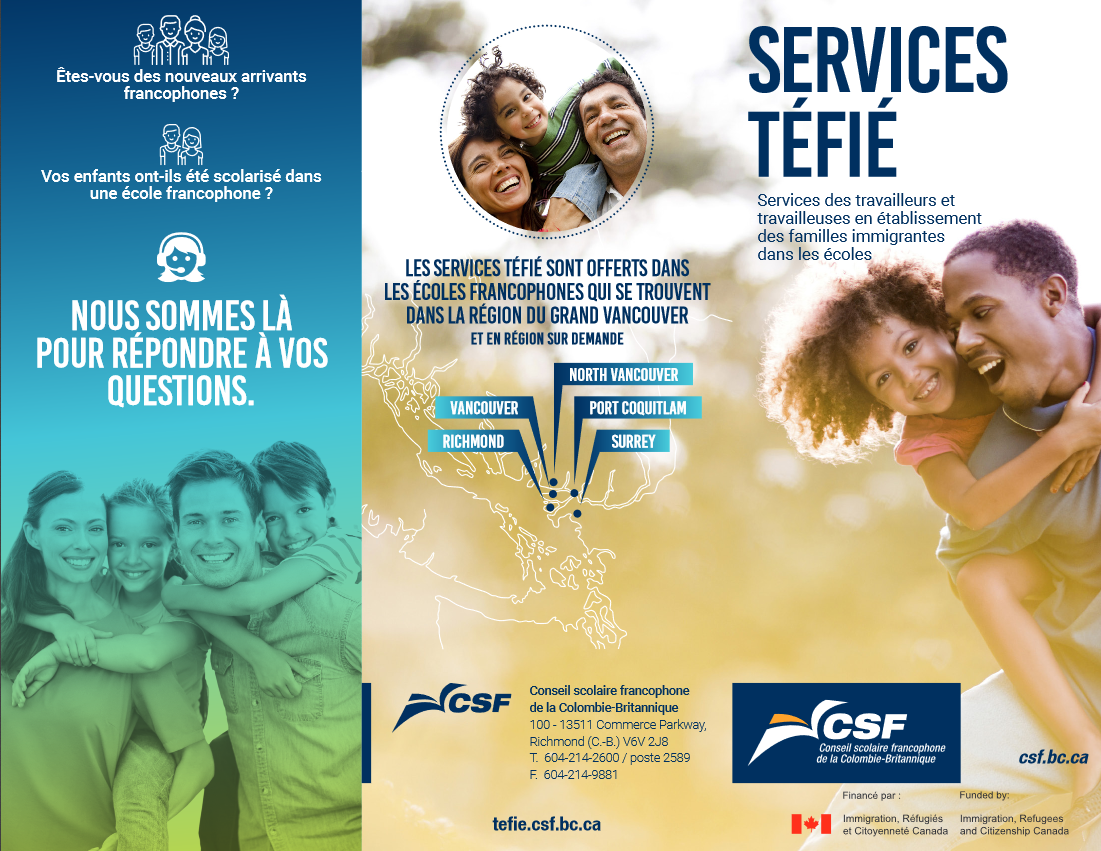
The participants left with an information folder including, among other things, a pamphlet about les Services TÉFIÉ, which can be found by clicking here.
Workshop/consultation on Promoting Early Childhood Health
Through fun, themed mini-sessions, this workshop sought to more precisely identify the needs for resources and programs aimed at promoting early childhood health for ages 0-6.
The workshop was held in the form of an interactive consultation and discussion, during which participants had the opportunity to share their views and experiences as parents, and also as representatives of parents’ associations. It was led by Marie Dussault, a consultant and social worker with a master's degree in public policy. The RésoSanté Colombie-Britannique team also took part in the workshop, in order to interact with the parents who participated.
This workshop/consultation was conducted as part of a partnership project for promoting early childhood health; the Fédération des parents is one of the partners involved with this. The experiences and opinions shared by the parents who took part in this consultation will be used to help direct the project, which will be implemented starting next spring; the goal is to improve the health of young children in Francophone families in British Columbia.


