LEGAL CASE
The Supreme Court of Canada will hear the case on French-language education in British Columbia

On April 11, 2019, the Supreme Court of Canada agreed to hear the appeal of a decision handed down by the British Columbia Court of Appeal on French-language education. Then, on May 13, the highest court in the country announced that it would hear the appeal on September 26, 2019.
The highest court in the country has therefore given a positive response to the application for leave to appeal filed by the Conseil scolaire francophone de la Colombie-Britannique (CSF), the Fédération des parents francophones de Colombie-Britannique and co-plaintiff parents.
The problems at the heart of this case – in particular, those relating to capital projects and the underfunding of school transportation – have the effect of exacerbating the level of assimilation in the province, as they lead significant numbers of parents to opt to enrol their children in French immersion or English-language programs rather than French-language programs. Research shows that such choices are detrimental to the transmission of the French language and Francophone culture to children living in a minority setting.
The Supreme Court of Canada has agreed to hear this case as it raises questions of public and national importance, notably :
- Substantive equality: The Supreme Court of British Columbia and the British Columbia Court of Appeal wrongly concluded that in order to determine whether there is equivalence between a CSF school and competing English-language or immersion schools, schools with similar populations and buildings with similar or identical capacities should be compared. This kind of analysis would almost always put the linguistic minority at a disadvantage. The B.C. courts are interested in the “proportionality” between school buildings; in this way, they distort the criterion of “substantive equality” laid down by the Supreme Court of Canada.
- 2. Section 1 of the Canadian Charter of Rights and Freedoms (the “Charter”): The appeal before the British Columbia Court of Appeal questioned Justice Russell’s finding that section 1 of the Charter could be successfully relied on by a province, regardless of its financial means. According to the British Columbia Court of Appeal, providing Francophones with the school buildings to which they are entitled would be too expensive. This is not only the first time a court of appeal has drawn such a conclusion, but until now, with few exceptions, only financial crises have led the Supreme Court of Canada to “justify” an infringement of rights guaranteed by the Charter.
- Damages for Charter violations: The trial judge found that, as a result of a decade of structural underfunding of school transportation, the Province of British Columbia must now compensate for that constitutional infringement by paying the CSF $6 million in damages. The appeal court judges rejected that finding. As a result of the criteria set out by the British Columbia Court of Appeal, it will be much less common for situations to justify ordering damages for those whose Charter rights have been violated.
It is also worth highlighting that significant gains regarding French-language education had been made following the decision of the Supreme Court of British Columbia, including the creation of a funding envelope specifically earmarked for capital projects for French-language education. These gains will in no way be affected by the Supreme Court of Canada’s ruling..
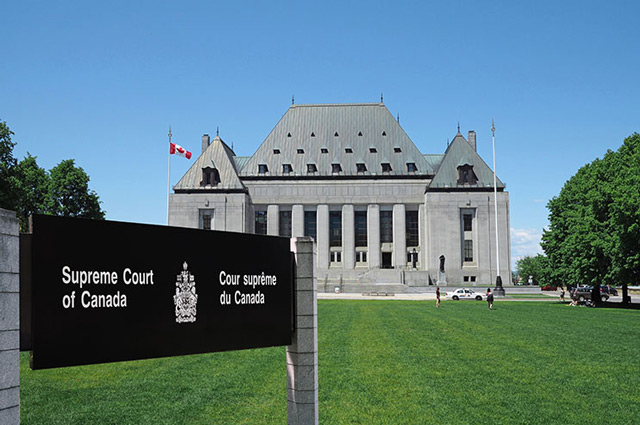
An audience which will be heard outside of the nation's capital
On May 13, 2019, it was announced that the appeal will be heard on September 26 of this year. This will mark the first time in history that the highest court in the country sits outside of Ottawa, as the judges will travel to Winnipeg, Manitoba. According to Chief Justice Richard Wagner, this initiative stems from the Supreme Court of Canada's commitment to increasing access to justice, and allow it to meet with Canadian citizens, who will have the opportunity to see the court at work.
“The appeal before the Supreme Court of Canada aims to diminish the effects of assimilation,” said CSF President Marie-Pierre Lavoie. “French is alive and well outside of Quebec! We exist and we must continue to fight for the respect of our rights.”
“In some provinces and territories, such as in Ontario, we are currently seeing policies emerge that are not in the interests of Francophones or Acadians,” noted Suzana Straus, President of the Fédération des parents. “Historically, the Supreme Court of Canada has come to the aid of minority Francophone communities when they have faced decisions by their provincial governments that did not respect Francophone rights, and this is what we hope the Court will do for BC Francophones,” she added.
The hearing itself will last less than one day. The Supreme Court judges will reach a decision following the audience. This decision will be final in this legal case.
To find out more about the legal case on French-language education in British Columbia, visit https://causejuridique.csf.bc.ca (website available in English and French).


